About Us
'Spatial Justice in the Postcolony: Legacies of the Nomos of Apartheid' is a research project, funded by the British Academy Newton Advanced Fellowship (UK) (2017-2020) and the National Research Foundation (SA) (2014-2016).
Spatial Justice in the Postcolony started as a small collaborative research project between Julia Chryssostalis (Co-Director: Westminster Law and Theory Lab) and Jaco Barnard-Naudé (Co-Director: Centre for Rhetoric Studies, University of Cape Town) when Julia visited Cape Town in 2012 and, in conversations with Jaco, problematised the ab-normality of South Africa’s ‘post’-apartheid spatiality. Julia was working on Carl Schmitt and Hannah Arendt’s divergent understanding of nomos at the time and Jaco had published an article on walls and remains after apartheid.
The project soon grew into an international collaborative effort and its first public academic event consisted of two panels at the 2015 Critical Legal Conference on space and law in Wrocław, Poland. In 2016 the project convened the Cape Town Spatial Justice Colloquium over two days in April, with speakers from universities across South Africa.

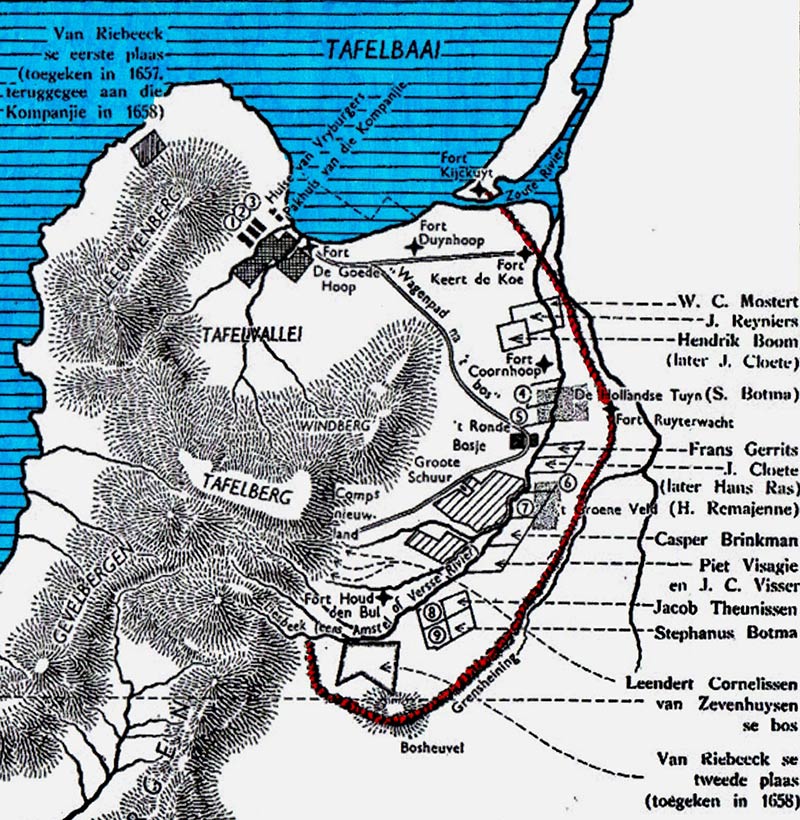
A Map Of The Original Colonial Boundary
A map of the original colonial boundary at the Cape of Good Hope: Van Riebeeck's Hedge (indicated in Afrikaans on the map as "Grensheining" (Boundary hedge)). As such, the map is a powerful representation of nomos as the concrete spatial instantiation of law's jurisdiction. Van Riebeeck's Hedge was erected to, as Alistair Sparks has put it, 'keep out the KhoiKhoi cattle herders who inhabited this southernmost tip of the African continent. With the mountain barrier behind, the hedge cut off Van Riebeeck’s little white community from the great African continent stretching away to the north, creating their own little enclave of Europe - six thousand miles from home’.
If, 'in the beginning was the fence', as Carl Schmitt has written (citing Jost Trier), then Van Riebeeck's Hedge marks the beginning of the colonial nomos in South Africa.
The remains of Van Riebeeck's Hedge are still visible today in the Kirstenbosch Botanical Garden in Cape Town. Like it, the nomoi of what it inaugurated (colonialism, imperialism, apartheid) also remain, albeit as fractured, displaced, interrupted and discontinued in its very continuity.
Our focus in this project is the underexplored nexus between spatial justice and post-coloniality. If nomos in its Schmittian configuration grounds law to the earth through land-appropriation, then how can nomos be thought otherwise in a time of decoloniality?
Send Us An Enquiry
Contact Info
Email: MDKUKH001@myuct.ac.za